The Tetons in the White House
It’s a hazy day in August 1879, and Thomas Moran is making sketches of the jagged, sawtooth skyline of the Teton Mountains. It’s a common technique for the landscape artist, who later will use the drawings as a reference for several original paintings.
What’s surprising is where he is standing. Rather than viewing the range from the eastern side, which had been gaining admiration since the creation seven years earlier of nearby Yellowstone National Park, Moran is traveling along Teton Creek to the west of the range. The renowned painter was impressed.
“The Tetons have loomed up grandly against the sky,” Moran wrote in his journal. “From this point, it is perhaps the finest pictorial range in the United States or even in North America.”
The western side of the mountain range is the only Teton perspective Moran ever saw. It’s a landscape that Teton Valley residents enjoy daily, while the more popular eastern side gets up to three million visitors a year and sometimes more.
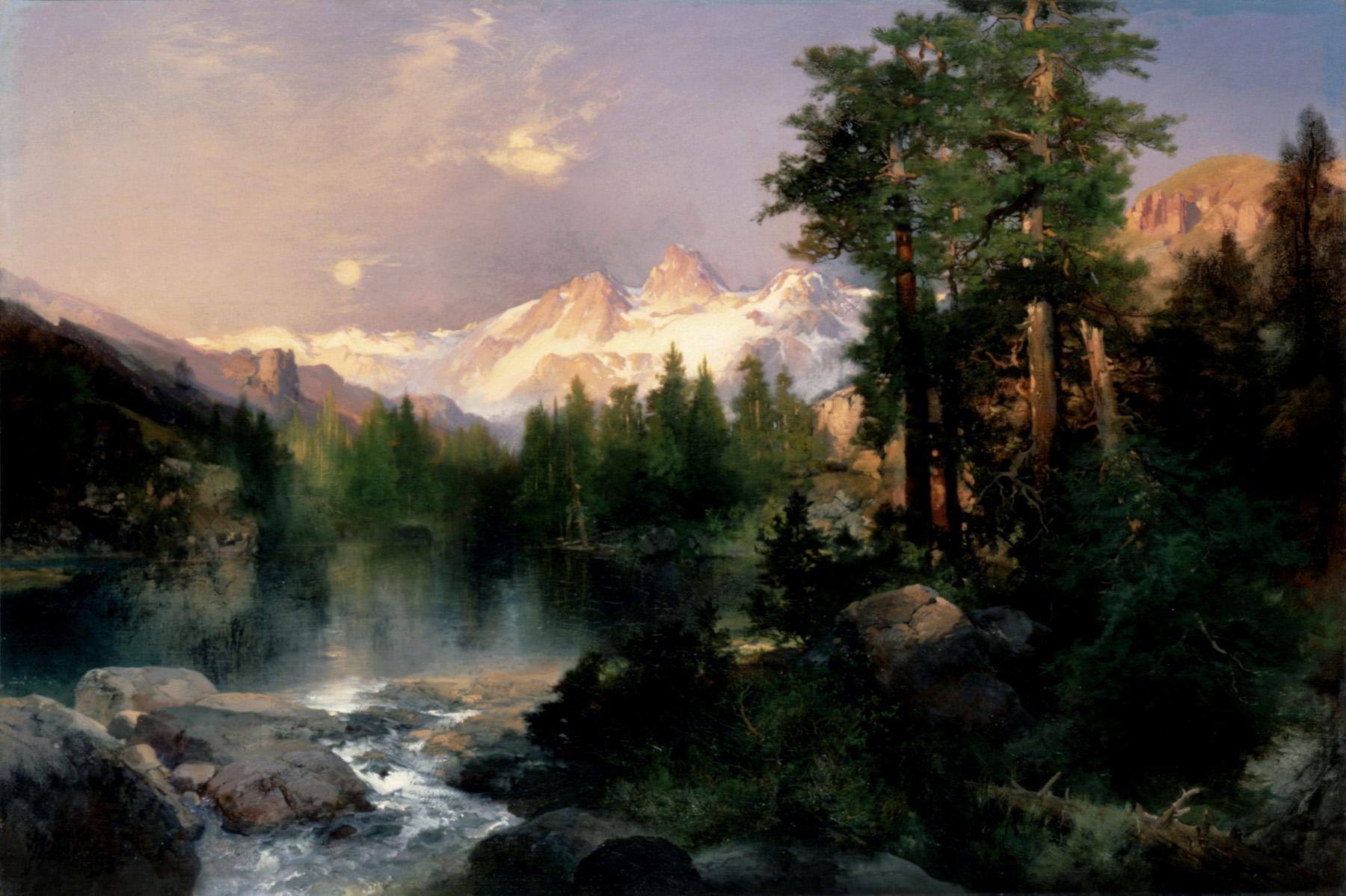
It is from his drawings that the artist would create the oil painting The Three Tetons in 1895. The piece shows the Grand, Middle, and South Tetons bathed in sunlight, contrasted with a foreground of dark evergreens and a mountain lake. The painting has been viewed by presidents, national lawmakers, world leaders, and other visitors while hanging in the Oval Office and West Wing of the White House. It has gained distinction for its use of intense color contrast, amplifying the grandeur of the Tetons, and for its celebration of the American West. The romanticization of the Wild West became an enduring chapter in American history, depicted in film, television, and fine art throughout the modern era. Moran’s art is an example of the start of that fascination.
The 1879 visit to this area wasn’t Moran’s first. His more famous journey west was an 1871 trip to Yellowstone with geologist Ferdinand Hayden and photographer William Henry Jackson. Sketches from those travels, sponsored by the U.S. Geological Survey, evolved into his painting The Grand Canyon of the Yellowstone, which convinced Congress not only to purchase the piece for $10,000 but also to approve the creation of the first national park.
Born in England in 1837, Thomas Moran moved to the United States as a young boy with his family. In Philadelphia, he worked first as a wood engraver, and then, as chief illustrator for the magazine Scribner’s Monthly. The latter job helped launch his artistic career.
Moran painted The Three Tetons while living on New York’s Long Island. He signed the painting “TYMORAN,” adding the “Y,” which stood for “Yellowstone,” to his initials in a stylized pictogram. The work was listed in his studio inventory as Lake & 3 Tetons.
The painting’s history isn’t well known prior to 1966. That’s when Cyrus Rowlett Smith, a native Texan, donated it to the White House. C.R., as he was known, was the first CEO of American Airlines.
Mostly based at his office in New York, he missed the West and began collecting artwork depicting the region in the 1930s. “Paintings should be acquired, owned, and preserved by those with a deep affection for them,” he once wrote.
C.R. preferred art that showed action and energy. He became friends with other collectors, who often teased one another in competitive ways. His financial advisers urged him to collect mainstream American Western artists, and he obtained pieces from several famous ones, including Moran.
“He appreciated their work, of course,” says Carolyn Appleton, who was a graduate student at the University of Texas in the 1980s and toured C.R.’s collection with the man himself. But, she added, a lot of it “bored him” and the thrill was in the collecting.
C.R. amassed extensive art holdings and eventually didn’t have room for it all. He began selling and donating pieces to museums and gave scores of paintings to his alma mater, the University of Texas at Austin. In the 1960s, he visited President Lyndon B. Johnson and his wife, Lady Bird, in the White House and would later cement the connection by becoming secretary of commerce.
“I never know quite what to make of C.R.,” wrote Lady Bird Johnson in her diary. “I believe he is generous, sincere, our friend. He never wastes a single word.”
In 1966, C.R. donated The Three Tetons to the White House. Exactly where the Johnsons displayed the painting isn’t known, and the White House Historical Association couldn’t confirm where it was located during the Nixon, Ford, and Carter administrations.
But the Tetons hung proudly in the Oval Office in the 1980s during the eight-year presidency of former California governor Ronald Reagan, who was fond of western art. George H. W. Bush and Bill Clinton also displayed the painting in the office. In 1997, it was released for a few months to the National Gallery of Art for a career retrospective of Thomas Moran’s work.
In 2001, after George W. Bush was elected, the painting was moved again. No surprise, really, because “W’s” vice president, Dick Cheney, was from Wyoming.
“Soon after we came into office, the President loaned me a painting of The Three Tetons that’s been in the White House collection for a long time and hung in the Oval Office for many years,” the vice president said at the 2007 dedication of the Craig Thomas Discovery and Visitor Center in Grand Teton National Park. “For nearly seven years it’s had a prominent spot on my office wall, as a daily reminder of my favorite place in the entire world.”
Barack Obama welcomed the landscape back to the Oval Office, hanging it across from his desk next to a portrait of George Washington. Joni Kinsey, an art historian and author of four books about Thomas Moran, was on a special tour of the White House in 2009 with a presidential aide when she encountered the work in the flesh.
“I remember seeing it in the Oval Office,” she says. “Thomas Moran’s Three Tetons is an important part of the White House collection, a visual and vivid glimpse of spectacular American scenery, renowned for its variety and sublimity.”
Though the trail went temporarily cold in recent years, The Three Tetons is now displayed in the West Wing Reception Room, and visitors on public tours can witness it firsthand.
Back in Teton Valley, local artist and Tetonia resident Sue Tyler often sets up an easel with Moran’s view of the Grand, Middle, and South Tetons.
“I love his use of warm and cool colors, clouds, and contrast between the mountains and foreground,” Sue says. “I think he hit his mark in this painting.”
In his diary from that August 1879 trip, Thomas Moran wrote that the Tetons were shrouded in smoke. Still, he said, they looked magnificent.
Thanks to his artistry, it’s the Teton Valley view that can be seen by the world.
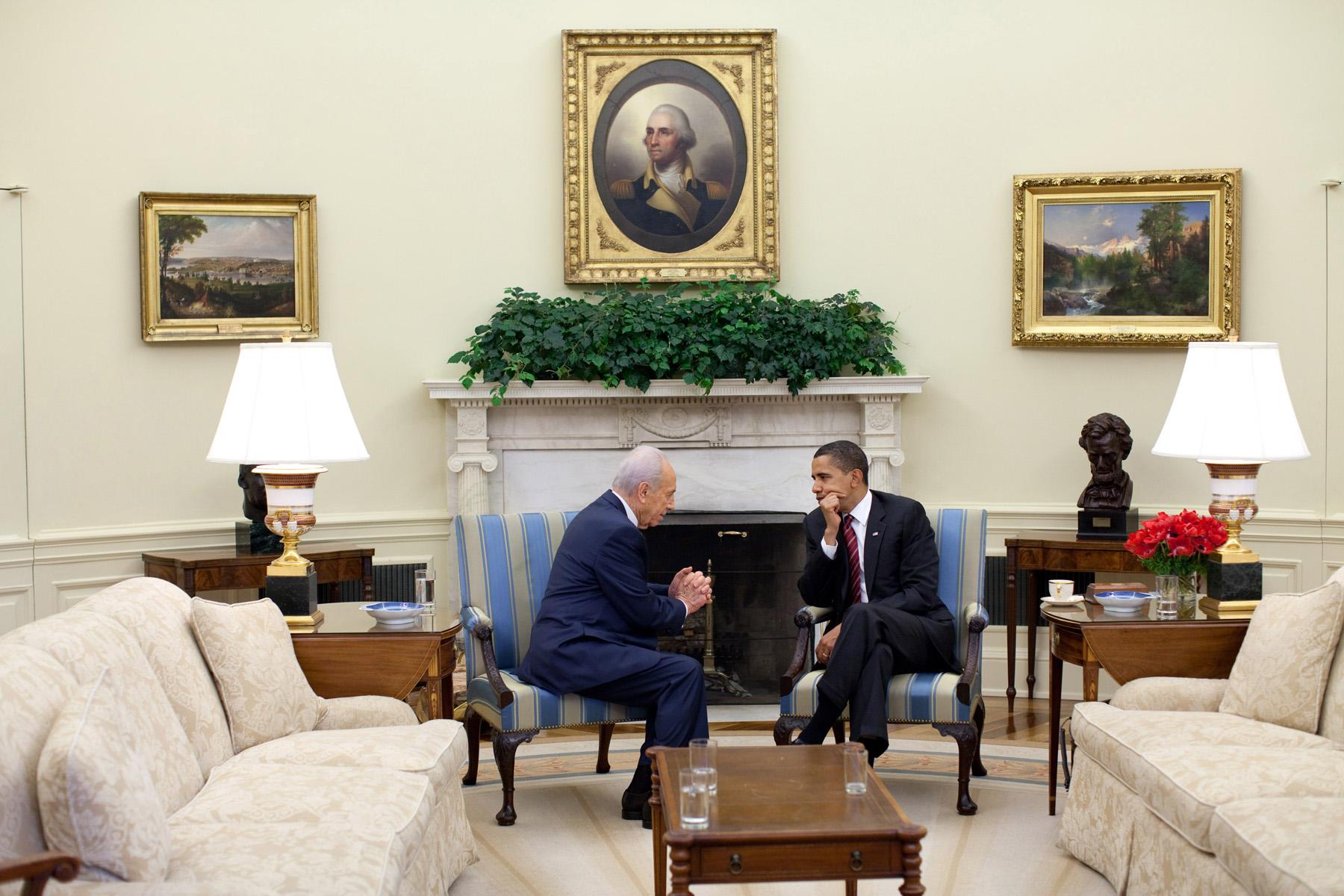
President Barack Obama meets with Israeli President Shimon Peres in the Oval Office Tuesday, May 5, 2009. Official White House Photo by Pete Souza
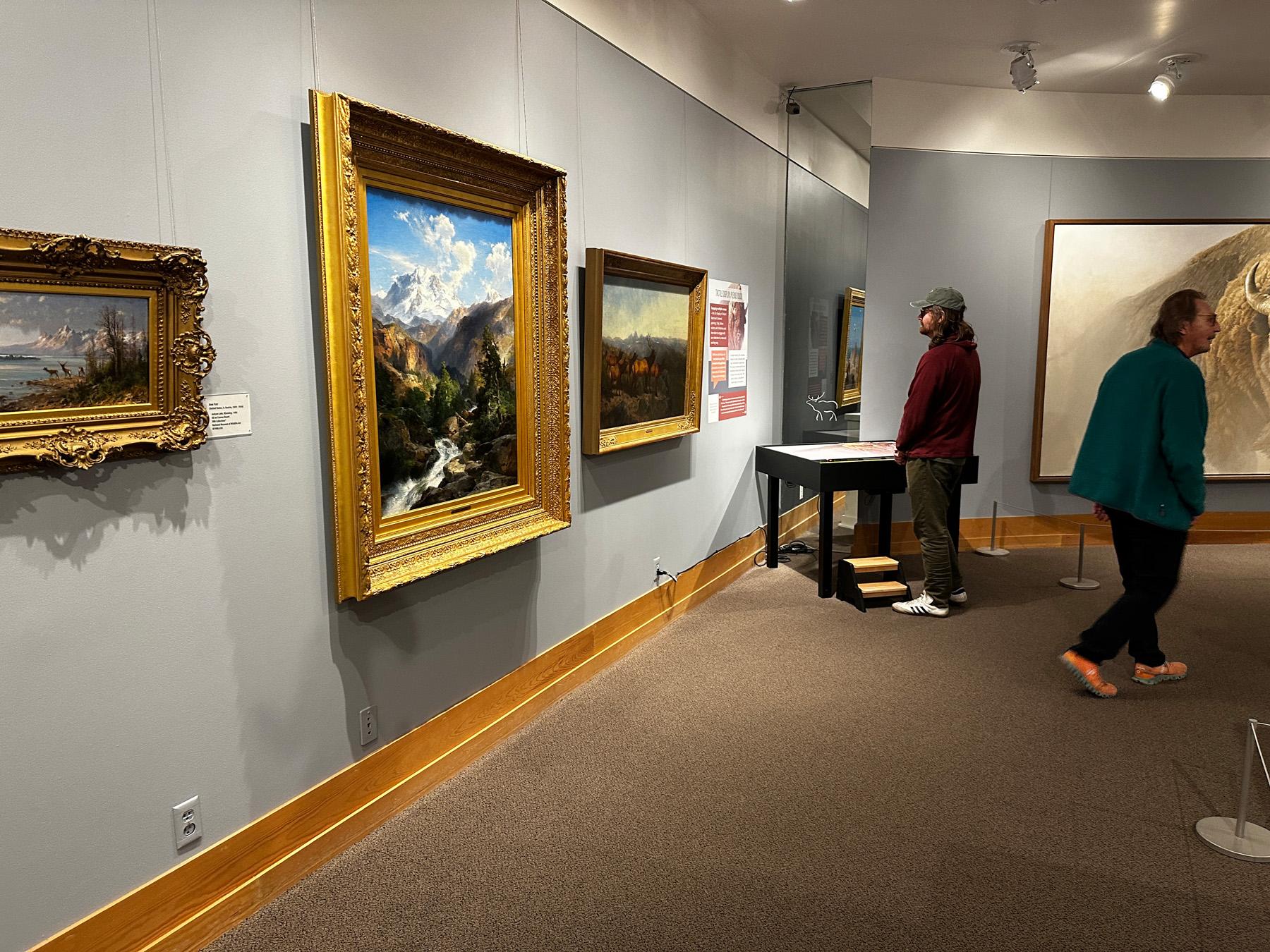
Nearby Places To See Moran’s Teton Paintings
National Museum of Wildlife Art in Jackson
Two oil paintings are on display in the first room as you enter the galleries:
• Mount Moran, Teton Range, Idaho, 1903
• Eternal Snows of Mount Moran, Teton Range, circa 1912
Jenny Lake Visitor Center in Grand Teton National Park
The visitor center has an exhibit spotlighting conservationist art, including:
• A small replica of The Grand Canyon of the Yellowstone, 1872
• A charcoal and pencil sketch, The Tetons, 1879
Signal Mountain Lodge in Grand Teton National Park
The lobby features:
• Prints of Moran’s watercolors depicting Yellowstone,
Colorado, Utah, and other vistas in the West